
CoolSculpting-in-London-and-Doctor-Led-Weight-Loss-Injections

CoolSculpting in London and Doctor‑Led Weight Loss Injections: Your Cavendish Clinic & Weight Medics Pathway

By Mr Matt James, Consultant Plastic Surgeon, FRCS (Plast)

Many patients now arrive at Cavendish Clinic having already started, or completed, a medical weight loss journey and want to know whether CoolSculpting can refine their shape. This guide explains how our London CoolSculpting service and our sister clinic, Weight Medics, work together – and how we plan safe, realistic pathways rather than “quick fixes”.

1. Cavendish Clinic, CoolSculpting and Weight Medics – how they fit together

Cavendish Clinic is a doctor‑led medical aesthetics clinic, known for delivering CoolSculpting Elite for stubborn localised fat, along with a wide range of skin and body treatments. Weight Medics is a dedicated, CQC‑regulated, medical weight loss clinic that provides structured doctor‑led programmes, including where appropriate the prescription of weight loss injections as part of a broader lifestyle plan. 

Together, this means we can help patients in London and beyond with both sides of the journey: reducing overall weight safely with medical supervision, then refining contours and addressing stubborn pockets of fat with CoolSculpting once weight is more stable. Rather than treating isolated areas in silos, we look at your health, weight, shape and skin quality as a whole, then sequence treatments accordingly. 

2. What CoolSculpting actually does

CoolSculpting is a non‑surgical fat‑reduction treatment that uses controlled cooling to target and permanently destroy fat cells just under the skin in specific areas such as the abdomen, flanks, thighs, back or under the chin. At Cavendish Clinic we use CoolSculpting Elite, the latest generation of this technology, which offers improved applicator shapes, dual applicators and more efficient treatment times compared with older devices. 

During a CoolSculpting session, a shaped applicator is applied to the chosen area, gently drawing tissue into the cup or holding it between cooling panels. The device then cools the fat layer to a precise temperature that injures fat cells while sparing surrounding skin, muscle and nerves. Over the following weeks, your body gradually clears the damaged fat cells, reducing the thickness of the fat layer and softening bulges. CoolSculpting is not a weight loss procedure, so you should not expect dramatic changes on the scales; instead, it is designed to improve contour in carefully selected problem zones.

3. What doctor‑led weight loss injections do (via Weight Medics)

Modern weight loss injections are prescription‑only medicines (often GLP‑1 or GLP‑1/GIP receptor agonists) that act on appetite‑regulating pathways in the brain and gut, helping suitable patients feel fuller sooner and reduce calorie intake when combined with lifestyle changes. In clinical studies and NHS guidance, these medicines have been shown to support significant weight loss in people with obesity or overweight and weight‑related health risks, especially when used alongside diet and physical activity.

At Weight Medics, weight loss injections are only prescribed after a full medical assessment, including BMI, medical history, current medications and relevant blood tests, and they are always part of a wider programme that includes nutrition and lifestyle support. Not everyone is suitable – there are clear contraindications (such as certain endocrine tumours, pregnancy and some gastrointestinal or kidney conditions), and potential side effects such as nausea or gastrointestinal upset that need careful monitoring.

4. CoolSculpting vs weight loss injections – which is right for you?

CoolSculpting and weight loss injections work in very different ways and are aimed at different types of patient. In simple terms:

  • Weight loss injections (via Weight Medics) are aimed at adults with a raised BMI and weight‑related health risks who need to lose a significant amount of weight for their health and wellbeing.
  • CoolSculpting at Cavendish Clinic is best suited to people who are already close to their healthy, sustainable weight but are bothered by specific, well‑defined areas of stubborn fat that do not respond to diet and exercise.

If your main concern is overall weight, dress size or health markers such as blood pressure or blood sugar, a medical weight loss programme through Weight Medics is usually the logical first step. If you are broadly happy with your weight but dislike particular bulges (for example, a lower tummy pouch, love handles or a double chin), CoolSculpting may be more appropriate. In many patients, the best results come from combining both – in sequence – rather than seeing them as either/or.
5. Combining CoolSculpting with weight loss injections – a typical pathway

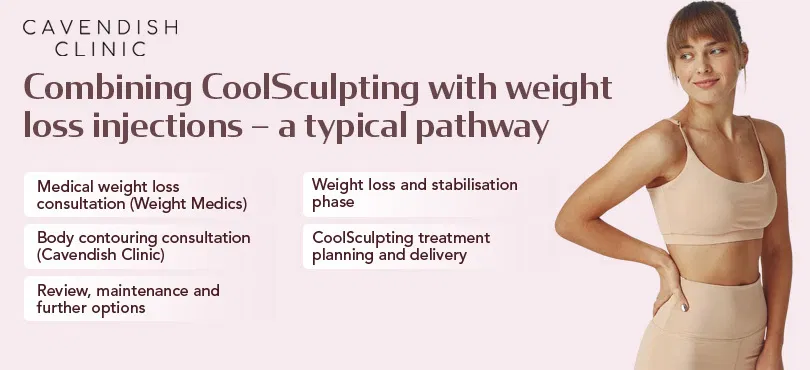
Combining CoolSculpting with weight loss injections – a typical pathway

Because Cavendish Clinic and Weight Medics work closely together, we can plan joined‑up pathways for patients who would benefit from both medical weight management and body contouring. A typical journey might look like this:

  1. Medical weight loss consultation (Weight Medics)
    You begin with a doctor‑led assessment at Weight Medics, where a clinician reviews your health, weight history, lifestyle, medications and goals, and may recommend a structured programme which can include weight loss injections if appropriate.
  2. Weight loss and stabilisation phase
    Over several months, you work on lifestyle changes supported by the medical team. If you start injections, doses are carefully titrated and monitored, with regular check‑ins to track weight, side effects and wellbeing. Once you approach or reach your target range and your weight has been relatively stable for a period of time, we can move on to contouring.
  3. Body contouring consultation (Cavendish Clinic)
    At this point, you meet the Cavendish Clinic team to assess areas of residual stubborn fat, skin quality and overall body proportions. We examine which areas genuinely contain pinchable, diet‑resistant fat suitable for CoolSculpting, and where skin laxity or muscle separation may require a different approach.
  4. CoolSculpting treatment planning and delivery
    Using CoolSculpting Elite, we design a personalised applicator “map” and treatment plan, often treating more than one area in a single visit thanks to dual applicators. Most patients will need more than one cycle per area for optimal results, with visible changes developing gradually over 3–4 months as the body clears treated fat cells.
  5. Review, maintenance and further options
    We review results and, where helpful, can layer in additional treatments for skin quality and laxity or refer back to Weight Medics for ongoing weight‑management support. For some patients, particularly those with significant loose skin after major weight loss, a separate consultation with me as a plastic surgeon is advisable to discuss surgical options such as lifts or tucks.

6. Safety and suitability: key points to understand

Both CoolSculpting and weight loss injections have clear safety criteria and are not suitable for everyone.

For CoolSculpting, important contraindications include rare cold‑related conditions (such as cryoglobulinaemia, cold agglutinin disease or paroxysmal cold haemoglobinuria), certain hernias in the treatment area, significant circulatory problems and active skin conditions at the site. Common temporary side effects include redness, bruising, swelling, numbness and discomfort, while a rare complication called paradoxical adipose hyperplasia can cause enlargement rather than reduction in a treated area and may require surgical correction.

For weight loss injections, your prescribing doctor will consider GI side effects, gallbladder and pancreatitis risk, specific endocrine and kidney conditions, and interactions with other medications. In the UK, these medicines should only be prescribed by suitably qualified clinicians within regulated services, and patients should avoid buying them online or from non‑medical providers.

Being treated within a medically led network like Cavendish Clinic and Weight Medics ensures both treatments are offered within their proper indications, and that you have access to appropriate follow‑up and complication management if needed.

7. What to ask at your consultation

To make the most of your consultation at Cavendish Clinic or Weight Medics, it helps to arrive with clear questions. You might ask:

  • Am I a better candidate for a medical weight loss programme, CoolSculpting, or both – and in what order?
  • How much change can I realistically expect from CoolSculpting in my specific areas, and how many cycles are likely?
  • Am I medically suitable for weight loss injections, and what are the main risks in my case?
  • How will we monitor my progress and adapt the plan if my results plateau or if side effects occur?
  • Are there signs of skin laxity or muscle separation that might limit what CoolSculpting alone can achieve, and should I consider a separate surgical consultation?

You should always feel free to seek a second opinion, and you should never feel pressured into same‑day procedures or packages that you do not fully understand. A good clinic will give you time, information and space to make the right decision for you.

8. Next steps: your Cavendish & Weight Medics journey

If you are interested in CoolSculpting in London, weight loss injections through a doctor‑led clinic, or both, the first step is a detailed consultation. At Cavendish Clinic, we can assess your anatomy, skin and goals and, where appropriate, coordinate closely with Weight Medics to design a safe, phased plan.

For some patients, that will mean starting with medical weight management and returning to us for CoolSculpting once weight has stabilised. For others, already near their ideal weight but frustrated by stubborn bulges, CoolSculpting may be the first line – with the reassurance that medical colleagues are available should a broader weight‑management approach be needed.

Medical disclaimer: This article is for general information only and does not constitute individual medical advice. Suitability for any treatment, including CoolSculpting and weight loss injections, must be assessed by an appropriately qualified healthcare professional in a face‑to‑face or regulated remote consultation.
Frequently Asked Questions

Yes, but most patients get better results if they wait until their weight has stabilised. While you are still losing weight on injections such as Semaglutide or Tirzepatide, your fat distribution keeps changing. An area treated too early may look different a few months later. We usually recommend CoolSculpting once your weight has been stable for around 3 months.

Most clinicians advise waiting until your weight has been stable for at least 3 months, whether or not you are still on medication. This lets your body settle. It also lets your clinician see clearly which areas are true stubborn fat and which are loose skin, so the treatment plan targets the right problem.

No. CoolSculpting reduces fat in specific areas such as the tummy, flanks, thighs or under the chin. It is not designed to lower your weight on the scales. It works best for people who are already close to a healthy, stable weight but have pockets of fat that do not shift with diet and exercise.

Clinical studies commonly report a reduction of around 20–25% in the fat layer of a treated area after one cycle. Results vary from person to person, and many patients choose more than one cycle per area. Changes appear gradually, and most people see their full result around 3–4 months after treatment.

The fat cells destroyed by CoolSculpting are cleared by the body and do not come back. However, the remaining fat cells in that area can still grow if you gain weight. Keeping your weight stable after treatment, through lifestyle changes or ongoing medical weight management, is the best way to keep your results.

No. CoolSculpting treats fat, not skin laxity. If you have loose skin after major weight loss, treatments such as [Morpheus8 Body] or [BodyTite] may help with mild to moderate laxity. Significant excess skin usually needs a surgical consultation to discuss options such as a tummy tuck or body lift.

Private weight loss injections are generally prescribed to adults with a BMI of 30 or above, or 27 or above with a weight-related health condition such as type 2 diabetes or high blood pressure. Lower BMI thresholds may apply to people of South Asian, Chinese, Black African or African-Caribbean background. A doctor must assess your suitability first.

Yes. When you lose weight quickly, part of what you lose can be muscle as well as fat. Eating enough protein and doing regular strength training helps protect muscle. Some patients also choose treatments such as [Emsculpt Neo] to support muscle tone during or after a medical weight loss programme.

Many people regain some of the weight they lost after stopping weight loss injections, especially if their lifestyle changes are not maintained. This is why a structured programme with nutrition support and a planned approach to stopping or reducing the dose matters. Your prescribing doctor should agree an exit plan with you.

Only buy weight loss injections from a regulated UK provider after a proper medical assessment. Pens sold through social media, beauty salons or unregulated websites may be fake, unlicensed or incorrectly dosed, and can cause serious harm. A registered prescriber should check your medical history, other medications and suitability before prescribing.

Common side effects are temporary redness, swelling, bruising, tenderness and numbness in the treated area. These usually settle within a few weeks. A rare side effect called paradoxical adipose hyperplasia (PAH) causes the treated area to enlarge instead of shrink, and may need surgical correction. Your clinician should discuss this risk before treatment.

Most people return to work and normal activities the same day. You may feel cold, tugging or aching during the first few minutes of a cycle, and the area can feel numb or tender for a few weeks afterwards. There is no need for anaesthetic or recovery time in most cases.