
Key takeaways
- Polynucleotides are purified salmon DNA injections that help skin repair itself.
- They improve skin quality and hydration without adding volume.
- The under-eye area is where they work best, softening dark circles and crepiness.
- Most patients need 2 to 3 sessions, spaced 3 to 4 weeks apart.
- Visible results usually appear within 2 to 3 weeks of a session.
- With a full course, results can last up to 6 months.
- Downtime is minimal, with mild swelling or bumps settling in 24 to 48 hours.
- At Cavendish Clinic, every treatment is doctor-led and starts with a consultation.
Polynucleotides are regenerative injectables made from highly purified fragments of salmon DNA. They help the skin repair itself, so it looks firmer, smoother and better hydrated over time. When we first wrote about them, they were still on their way to our Fitzrovia clinic. They are now fully available, and our doctors offer polynucleotides for the face and under eyes as part of our regenerative injectables range.
If you have been reading about “salmon DNA injections” and wondering whether the fuss is justified, this guide is for you. We cover how polynucleotides work, what they can and cannot do, how many sessions you need and what recovery really looks like. We have also added the questions our patients ask us most often in consultation..
What are polynucleotides?
Polynucleotides, often shortened to PN or PDRN (polydeoxyribonucleotide), are long chains of nucleotides. Nucleotides are the building blocks of DNA and RNA, and each one is made of a sugar, a phosphate group and a nitrogenous base.
In aesthetic medicine, the polynucleotides used are usually taken from salmon or trout DNA. The reason is practical: fish DNA is very similar to human DNA in structure, and once it is purified, the body accepts it well. The purification step removes proteins and other material that could trigger a reaction, leaving clean DNA fragments behind.
They have a longer history in medicine than most people realise. Polynucleotides were first used in wound care and tissue repair, and that regenerative background is exactly why they moved into skin rejuvenation.
How do polynucleotides work?
Think of them less as a filler and more as a support system for your own cells. Once injected, polynucleotides are thought to encourage fibroblasts, the cells that make collagen and elastin, to work harder. They also attract and hold water, which explains the hydration boost many patients notice early on.
There’s an anti-inflammatory side to them too. Lower background inflammation gives the skin a better environment to repair, which matters most in thin, delicate areas like under the eyes.
What they don’t do is add volume. You won’t see an instant change in shape the way you would with dermal filler. The improvement builds gradually as your skin rebuilds itself, which is why results look natural rather than “done”. If your main concern is sagging or lost definition along the cheeks and jawline, a lifting treatment like HArmonyCA is usually a better match, and some patients combine the two.
The benefits of polynucleotides
Patients usually come to us with one main concern, often tired-looking eyes, and leave noticing changes they hadn’t expected. These are the improvements polynucleotides are best known for.
Brighter, less tired-looking under eyes
The under-eye area is where polynucleotides really earn their reputation. The skin here is thin, so dark circles, crepiness and fine lines show up early. Polynucleotides help thicken and hydrate this skin, which can soften shadows and make the area look fresher. Because they don’t add volume, they are often a better fit for the under eyes than filler, especially if you are prone to puffiness.
Softer fine lines and wrinkles
By supporting collagen production, polynucleotides can reduce the look of fine lines over a course of treatment. They work best on early, fine lines and crepey texture. Deeper wrinkles caused by muscle movement respond better to anti-wrinkle treatments, and the two can be combined.
Better skin texture and firmness
Patients often say their skin feels “thicker” and bouncier after a course. Improved hydration and elasticity help smooth uneven texture, and some people see an improvement in mild scarring.
A more even skin tone
Polynucleotides may also help fade pigmentation and even out skin tone, giving a clearer, brighter complexion. Results vary with this one, and stubborn conditions such as melasma usually need a wider plan that includes skincare and SPF.
What about hair loss?
Polynucleotides are used on the scalp in some clinics. At Cavendish Clinic, our polynucleotide treatment focuses on the face and under eyes. If thinning hair is your concern, our doctors usually recommend Exosome Hair Rejuvenation or PRP Hair Therapy instead.
Where are polynucleotides injected?
At Cavendish Clinic, we treat two main areas with polynucleotides: the under eyes and the wider face. Elsewhere, they are also used on the neck, hands and décolletage. The right area for you depends on your goals, and your doctor will talk this through at your consultation.
Who are polynucleotides good for?
You may be a good candidate if you have:
- dark circles, hollowness or crepey skin under the eyes
- dull, dehydrated skin that hasn’t improved with skincare alone
- early fine lines and loss of firmness
- uneven texture or tone
- a preference for subtle, natural-looking change over added volume
Many of our patients are in their thirties and forties and want to look fresher rather than different. Polynucleotides suit that brief well. If you are just starting to notice the first signs of ageing, our doctor-led guide to fine lines and early ageing in your 30s explains how to slow them down.
Who should avoid them?
Polynucleotides aren’t suitable for everyone. Your doctor will usually advise against treatment if you are pregnant or breastfeeding, have a fish or salmon allergy, have an active skin infection in the area, or have certain autoimmune conditions. Be open about your medical history and medication at consultation, as it helps us keep you safe.
Polynucleotides vs Profhilo: what’s the difference?
This is one of the questions we hear most. Both are skin boosters, but they work in different ways.
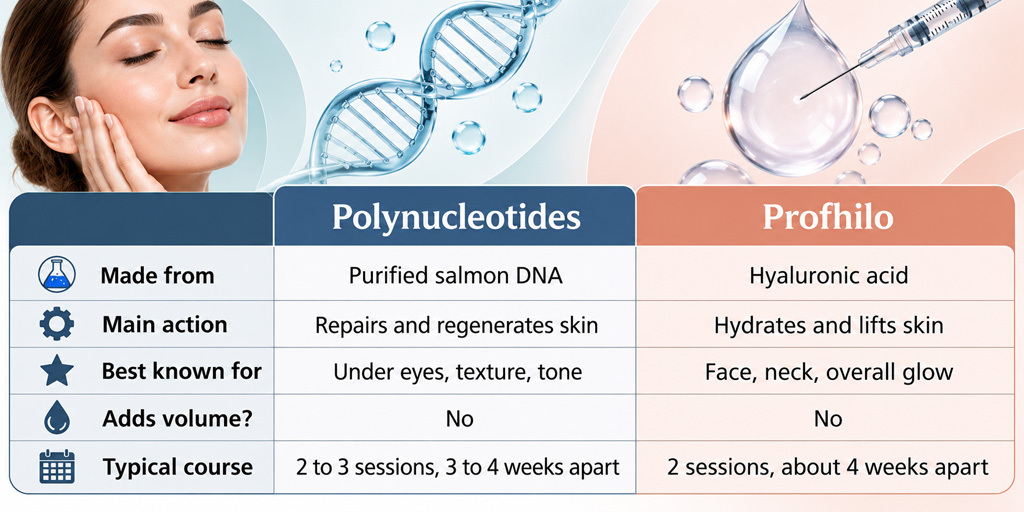
Polynucleotides are generally the better pick for the under-eye area and for skin quality problems such as thinness and pigmentation. Profhilo shines when the main goal is deep hydration and a gentle lift across the face and neck. Some patients have both, spaced out over a few months, and that combination often gives the best overall result. Your doctor can tell you which order makes sense for your skin.
How many polynucleotide sessions will I need?
For most people, we recommend a course of three treatments, spaced three to four weeks apart. That gap gives your skin time to respond and rebuild between sessions. If your concerns are milder, your doctor may suggest a shorter course of two.
After the initial course, a maintenance session roughly every six months helps keep results going.
What happens during treatment?
Each appointment takes about 30 to 45 minutes. Your doctor will cleanse the skin and may apply numbing cream first. The polynucleotide gel is then injected in small amounts using a fine needle or cannula. Most patients describe it as a stinging or pinching feeling rather than real pain, and the under-eye area tends to be the most sensitive.
You’ll notice small raised bumps where the product has gone in. That’s normal. They usually flatten within a day or two as the gel settles into the skin.
When will I see results, and how long do they last?
Polynucleotides are a slow burn, and that’s part of their appeal. Visible improvements typically appear within two to three weeks of a treatment, with the skin looking smoother, clearer and brighter. Results then build with each session, and the full effect is usually clear a few weeks after your final treatment.
With a full course, results can last up to six months. How long they last for you depends on your age, skin condition and lifestyle. Sun exposure, smoking and poor sleep will all shorten the lifespan of any skin treatment.
Aftercare: what to expect afterwards
Mild swelling, redness or small bumps are common straight after treatment and normally settle within 24 to 48 hours. Some people get a small bruise, particularly under the eyes.
For the first 24 hours, we recommend that you:
- skip make-up on the treated area
- avoid exercise, saunas, steam rooms and hot baths
- don’t rub or massage the area
- use a gentle moisturiser
After that, wear SPF every day. It protects the new collagen you are building and helps your results last longer.
Are there any side effects?
Polynucleotides have a good safety profile, and serious side effects are rare when the treatment is done by a trained medical professional. The most common effects are the ones covered above: swelling, redness, small bumps and occasional bruising, all short-lived.
As with any injectable, there is a small risk of infection or allergic reaction. This is one reason a proper medical consultation matters so much, and why we never treat without one.
How much do polynucleotides cost in London?
The cost of polynucleotides under eyes, or across the wider face, depends mainly on how many sessions you book. A course of two or three works out cheaper per session than booking single treatments, and it is also how most people get the best results. Your doctor will confirm the exact price at your free consultation, once they know which areas you want treated. If you’d prefer to spread the cost, we also offer payment with Klarna.
When you compare clinics, check who is actually doing the injecting. A lower price often reflects a less qualified practitioner, and with injectables around the eyes, experience counts.
Why choose Cavendish Clinic for polynucleotides?
At Cavendish Clinic, every injectable treatment is carried out by highly qualified, experienced doctors. That’s not the case at every clinic in the UK, where injectables can legally be given by non-medical practitioners.
Doctor-led care means precise technique and a proper understanding of facial anatomy. It also means someone who can assess whether polynucleotides are actually right for you, and will tell you honestly if another treatment would serve you better.
Every polynucleotide treatment starts with a doctor-led consultation to check your suitability. New clients receive a complimentary consultation at our clinic in Fitzrovia, central London.
Book your polynucleotide consultation
If tired eyes or dull, thinning skin have been bothering you, polynucleotides are worth a conversation. They won’t change how you look overnight, and that’s the point. Over a few weeks, your skin simply starts to look healthier and more rested.
Call our Fitzrovia team on 0207 935 4410 to book your complimentary consultation. Your doctor will talk through your goals, check that the treatment suits you and explain your course options and prices.