
The minute the sun makes an appearance in Fitzrovia, you can almost guarantee a queue forms outside the ice cream van on Charlotte Street and everyone’s sleeves roll up a bit early. It’s lovely, honestly. But it’s also exactly when most of us stop thinking about our skin properly and just hope for the best. Dr Matt James, who founded Cavendish Clinic, sees the results of that “hope for the best” approach pretty often, and his advice is always the same: a few small habits now save you a lot of bother later.
July happens to be UV Safety Awareness Month, which gives us a decent excuse to actually sit down and go through what’s worth knowing this summer, particularly if you’re based around central London and spend a fair bit of time outdoors.
Dr Matt James is a GP and the founder of Cavendish Clinic, Fitzrovia, with years of clinical experience in skin health and aesthetic medicine. He regularly advises patients on sun protection and skin ageing, and this guidance reflects current dermatological understanding rather than generic seasonal tips found elsewhere online.
Sun damage isn’t just a holiday problem
There’s a common assumption that skin damage mostly happens during childhood summers, or that one bad holiday in Spain years ago. It’s not quite that simple. Dermatologists have found that UV exposure builds up steadily across a lifetime, and a good portion of it actually happens well after people turn 40, long after most of us have stopped thinking about sunscreen as a daily habit rather than a holiday one.
Skin ageing tends to fall into two camps. There’s intrinsic ageing, which is just the natural process none of us can dodge, and then there’s extrinsic ageing, caused by things like UV light, pollution and other environmental nasties. The second type is largely avoidable, which is really the whole point of this article.
What actually helps
Nothing revolutionary here, but consistency is where most people fall down:
Stay out of direct sun between midday and 4pm if you can help it, that’s when UV is strongest, even if it doesn’t feel particularly hot.
Hats and sunglasses do more than people give them credit for. They protect the bits sunscreen often misses, like your scalp parting or your eyelids.
Pick a proper SPF30 or SPF50, broad spectrum, and don’t skimp on it. We’re fans of SkinCeuticals at the clinic, mostly because the formulations hold up well under London’s unpredictable weather. You’ll find our full range over on the Skincare Shop.
And reapply. This is the one everyone forgets. Sunscreen wears off, especially if you’re sweating or in and out of water, so every couple of hours is a sensible rule of thumb.
If you’re not sure what’s right for your skin, we do free consultations at the clinic, it’s worth popping in rather than guessing.
UVA and UVB, what’s the actual difference
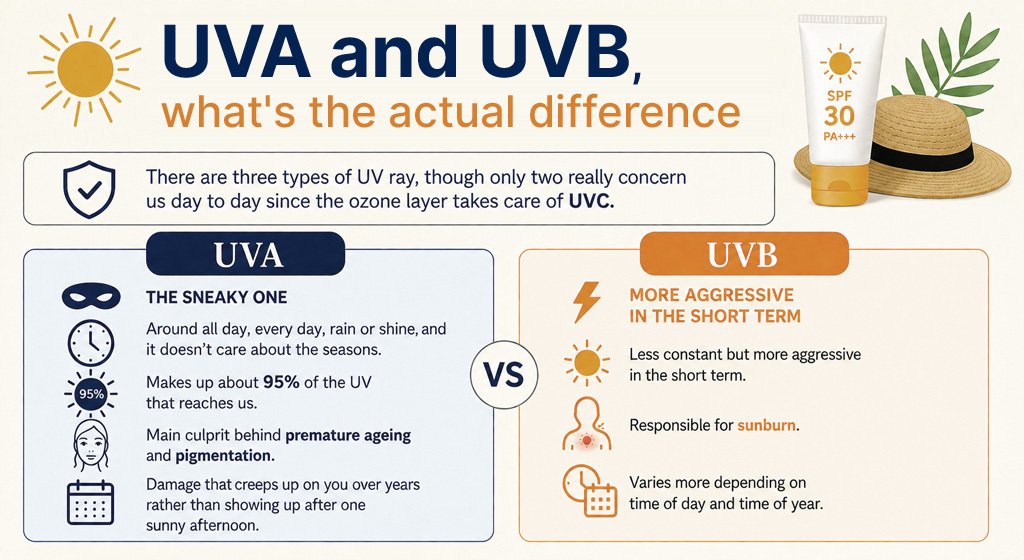
There are three types of UV ray, though only two really concern us day to day since the ozone layer takes care of UVC.
UVA is the sneaky one. It’s around all day, every day, rain or shine, and it doesn’t care about the seasons. It makes up about 95% of the UV that reaches us and it’s the main culprit behind premature ageing and pigmentation, the kind of damage that creeps up on you over years rather than showing up after one sunny afternoon.
UVB is less constant but more aggressive in the short term. It’s responsible for sunburn and tends to vary more depending on time of day and time of year.
Because UVA never really switches off, sunscreen genuinely isn’t just a summer thing. It should be part of your routine all year, even on grey days, even in February.
A couple of practical notes depending on skin type: if you’re prone to oiliness or breakouts, go for something mattifying or tinted so you’re not adding extra shine. Drier or more mature skin types tend to do better with something a bit more hydrating, especially on the neck and hands, which get forgotten far too often.
Don’t skip the face
Your face takes the brunt of UV exposure simply because it’s almost always uncovered, and the skin there is thinner than most other parts of the body, which makes it more vulnerable. It’s also usually the first place sun damage shows up, whether that’s fine lines, dullness or patches of pigmentation.
Daily facial SPF really isn’t negotiable if you want your skin to age well. Combining that with treatments like our HydraFacial Deluxe with SkinCeuticals can help undo some existing damage while keeping the skin barrier in decent shape going forward. If pigmentation or uneven tone is already bothering you, our Exosome Skin Rejuvenation treatment is also worth a look.
In fairness, sun isn’t all bad
It would be a bit unfair to make the sun sound like the enemy. In sensible doses, it does some good:
It helps the body make Vitamin D, which matters for bone health. It triggers melanin production, giving you a tan and a small amount of natural protection. It improves blood flow through vasodilation. Some people find it eases symptoms of psoriasis, acne or vitiligo. And there’s the mood boost, most of us just feel better when the sun’s out, which counts for something.
The line between “beneficial” and “harmful” really just comes down to how much and how often. Ten minutes is very different from two hours.
Worth a read too: Holiday Skincare Essentials and 11 Expert Tips for Glowing, Healthy Skin
Kids need this even more than adults do
Sun habits picked up young tend to stick, for better or worse. A lot of skin cancer diagnosed later in life traces back to poor sun protection during childhood, so getting kids into the habit of SPF and hats isn’t overly cautious parenting, it’s genuinely one of the more useful things you can teach them.
The short version
Enjoy the summer. Just don’t go into it unprotected. SPF30 or 50, reapplied properly, plus some common sense about timing and clothing, covers most of it. If you’d like more specific advice, particularly if you’re already dealing with sun damage or pigmentation, book a free consultation with the team at Cavendish Clinic in Fitzrovia.