

Key Takeaways
- Skin laxity is loss of firmness caused by declining collagen and elastin.
- Doctors grade laxity as mild, moderate or severe to guide treatment.
- Sun, menopause, weight loss and smoking all speed up skin loosening.
- Mild laxity responds best to skin quality care and gentle collagen stimulation.
- Moderate laxity usually needs deeper radiofrequency or microneedling treatments.
- Severe laxity with genuine excess skin often needs a surgical opinion; minimally invasive contouring may suit carefully selected patients only.
- A doctor led assessment matters more than choosing a trending treatment.
Skin laxity is the medical term for skin that has lost its firmness and no longer springs back the way it used to. Doctors grade it as mild, moderate or severe, and that grade is the single biggest factor in deciding which treatment will actually work for you.
Many people arrive at a consultation already set on a procedure they have seen on social media. A good doctor will gently pause that conversation and look at the skin first. The same treatment that gives a 35 year old a sharper jawline may do very little for someone with folds of skin after major weight loss, and recommending it anyway only leads to disappointment.
At Cavendish Clinic, every treatment plan begins with an assessment of laxity rather than a menu of options. This guide explains what each grade looks like, why skin loosens in the first place, and how a doctor matches the right treatment to the right skin. By the end, you should be able to look in the mirror and have a realistic idea of where you sit on the scale.
What Is Skin Laxity and What Causes It?
Skin laxity happens when the two proteins that keep skin firm, collagen and elastin, break down faster than the body can replace them. Collagen gives skin its structure, while elastin lets it stretch and recoil. When both decline, skin becomes thinner, softer and more likely to sag.
From our mid twenties onwards, the body produces roughly 1 percent less collagen each year. On its own, that is a slow process. Several factors speed it up considerably:
- Sun exposure. Ultraviolet light damages collagen fibres and is responsible for a large share of the visible ageing seen on the face, neck and hands.
- Hormonal change. Studies suggest women can lose around 30 percent of their skin collagen in the first five years after menopause.
- Weight change. When skin has been stretched over a larger frame for months or years, its elastic fibres can lose the ability to contract once the weight comes off.
- Smoking and pollution. Both create oxidative stress that weakens the support network beneath the skin.
- Genetics. Some people simply inherit thinner skin or weaker connective tissue.
Weight loss deserves special mention because it is one of the most common reasons people seek help today. Rapid loss, particularly with newer weight loss medications, gives skin very little time to adapt. If this applies to you, our guide on Loose Skin After Weight Loss covers the facial and body changes in more detail.
It is also worth knowing that laxity is not the same as volume loss. Hollow cheeks or temples come from fat and bone changes, whereas laxity is about the skin envelope itself. Most people have a mix of both, which is exactly why a proper assessment matters.
How Do Doctors Grade Skin Laxity?
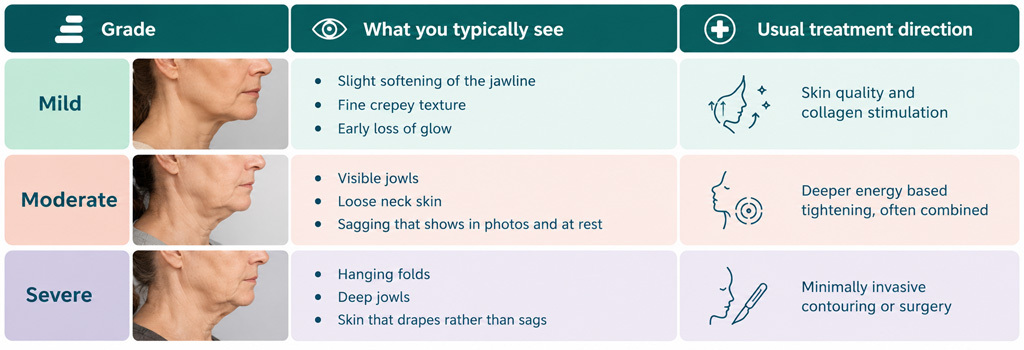
Doctors grade skin laxity by looking at how far the skin has descended, how well it recoils, and whether there is excess skin that cannot be tightened back into place. There is no single universal scale, but most clinicians use a simple three tier system.
During an examination, a doctor will usually check several things:
- The snap test. Skin is gently pinched and released. Healthy skin returns instantly, while lax skin returns slowly.
- Position change. Skin is assessed sitting upright and lying down to see how much gravity is involved.
- Skin thickness and quality. Thin, sun damaged skin responds differently from thicker, oilier skin.
- Fat and volume. The amount of fat under the skin affects which devices are suitable.
- Your goals and downtime. A plan only works if it fits your life.
Age is a guide, not a rule. We regularly see people in their thirties with moderate laxity after weight loss, and people in their sixties whose skin is only mildly lax thanks to good genetics and diligent sun protection.
Mild Skin Laxity: Signs and Best Treatments
Mild laxity is best treated by improving skin quality and gently stimulating new collagen, rather than by aggressive tightening. At this stage, the structure is still largely intact. The aim is to protect it and slow further decline.
You may have mild laxity if you notice that your makeup sits differently, your jawline looks slightly less crisp in certain lighting, or the skin under your eyes has a faint crepey texture. Friends would not describe you as looking tired, but you can see the change.
Treatments a doctor might suggest at this stage include:
- Medical grade facials. A HydraFacial Deluxe with SkinCeuticals cleanses, exfoliates and infuses antioxidant serums. It will not lift sagging skin, but it improves hydration and radiance, which makes skin look firmer and healthier.
- Regenerative treatments. Exosome Skin Rejuvenation uses tiny signalling particles to support repair and encourage the skin to renew itself. It pairs well with microneedling and suits people who want a natural, gradual improvement.
- Light radiofrequency sessions. A short course of gentle heat based treatment can nudge collagen production with little or no downtime.
- A sensible skincare routine. Daily SPF 30 or higher, a retinoid at night and a vitamin C serum in the morning remain the best value investments anyone can make.
The honest truth is that mild laxity responds well to consistency. Small, regular treatments often achieve more than one dramatic procedure, and they keep you ahead of the curve.
Moderate Skin Laxity: Signs and Best Treatments
Moderate laxity usually needs energy based devices that heat the deeper layers of the skin, because surface treatments alone cannot reach the tissue that has started to drop. This is the stage where most people first book a consultation.
Common signs include early jowls, softening along the jawline that is visible at rest, loose skin on the neck, and lines running from the nose to the mouth that look deeper than they used to. On the body, it may show as softness on the tummy, inner arms or thighs that does not improve with exercise.
Treatment options at this stage typically include:
- Fractional laser skin resurfacing. Fractional laser treatments deliver controlled energy into targeted areas of the skin, stimulating the body’s natural repair response and supporting collagen remodelling. Depending on the laser type and treatment settings, they can help improve skin texture, fine lines, mild skin laxity and overall skin quality. Non-ablative fractional lasers generally involve less downtime, while ablative fractional lasers can deliver more intensive resurfacing with a longer recovery period. For moderate laxity, fractional lasers may be particularly beneficial when skin texture and fine lines are also concerns, although they are not a substitute for surgical lifting when significant excess skin is present. A consultation is essential to select the appropriate laser based on skin type, concerns and downtime tolerance.
- Radiofrequency microneedling. This combines fine needles with radiofrequency energy to reach deeper tissue. For loose skin on the stomach, arms or thighs, Morpheus8 Body for Loose Skin can tighten and remodel areas that creams and exercise cannot touch.
- Supporting treatments. Doctors often add collagen stimulating injectables or regenerative therapies to boost the overall result.
Results at the moderate stage develop gradually as collagen remodelling takes place. Depending on the treatment, device used and degree of skin laxity, a minimum of three to six sessions may be recommended to achieve optimal improvement, followed by annual maintenance treatments to help maintain results. The exact treatment plan will vary according to individual needs and clinical assessment. Expectations are important: these treatments can improve skin firmness, texture and overall definition, but they do not reposition underlying tissues in the same way as surgery.
Severe Skin Laxity: Signs and Best Treatments
Severe laxity is different from simply softened skin. Where there is genuine excess skin, surgery is often the most effective option, and minimally invasive contouring should not be seen as a substitute for it. In carefully selected patients, a minimally invasive treatment may still offer a meaningful improvement, but this can only be judged at a face to face assessment. Devices that work from the surface can still help, but on their own they rarely deliver the change a person with severe laxity is hoping for.
Signs of severe laxity include deep jowls that hang below the jawline, heavy folds on the neck, skin that drapes when you look down, and on the body, overhanging skin after significant weight loss. At this stage, there is often genuine excess skin rather than skin that has simply softened.
Options a doctor might discuss include:
- Minimally invasive radiofrequency contouring, for selected patients. FaceTite offers a minimally invasive option for patients looking to improve skin laxity, refine facial contours and achieve a more defined jawline without the need for a traditional facelift. It may be particularly appealing to those seeking a more sculpted, firmer appearance with less extensive intervention and downtime than surgery. Best suited to appropriately selected patients with mild to moderate skin laxity, FaceTite can help bridge the gap between non-surgical treatments and surgical procedures. For those with more significant excess skin, a personalised consultation will help determine whether FaceTite can deliver a meaningful improvement or whether surgical options may be more appropriate. The aim is to achieve natural-looking results while matching the treatment to each patient’s anatomy, concerns and expectations. As an invasive procedure, it is performed under local anaesthetic through small entry points, which leave tiny scars that usually fade over time.
- Combined approaches. Where FaceTite is suitable, it is frequently followed by external radiofrequency microneedling to refine the skin surface.
- Surgical referral. When there is a large amount of genuine excess skin, surgery such as a facelift, neck lift or skin removal is usually the most appropriate option. A responsible doctor will tell you this, even if it means you leave without booking a treatment that day.
That last point is important. Recommending a device to someone who truly needs surgery wastes their time and money. Good clinics put the right outcome ahead of the sale.
How Does a Doctor Choose Your Treatment?
A doctor chooses your treatment by combining your laxity grade with your skin type, medical history, budget and tolerance for downtime. The grade narrows the options, and everything else decides which one fits you best.
A thorough consultation usually follows these steps:
- Medical history. Your doctor asks about medications, previous treatments, weight changes and any conditions that affect healing.
- Skin examination. Laxity, skin thickness, fat distribution and sun damage are assessed in good light and from several angles.
- Clinical photographs. These create a baseline so progress can be measured objectively.
- Goal setting. You explain what bothers you most, and the doctor explains what is realistically achievable.
- A written plan. This covers the recommended treatments, number of sessions, expected recovery and costs.
Who performs that assessment matters. Energy based devices and minimally invasive procedures carry real risks when used without medical training. Before booking anywhere, it is worth checking the qualifications of the practitioners. You can Meet the Team at our clinic to see the doctors who carry out these consultations.
Can Treatments Be Combined?
Yes, and combination plans usually give better results than any single treatment. Skin laxity rarely exists on its own. Most people also have some volume loss, texture change or pigmentation. A typical plan might tighten deeper tissue first, refine the surface next, and then maintain results with regular skin quality treatments. Your doctor will space treatments safely so each one has time to work.
Final Thoughts: Start With the Right Diagnosis
The most effective skin laxity treatment is the one matched to your grade, not the one trending online. Mild laxity rewards consistent skin quality care. Moderate laxity responds well to deeper radiofrequency treatments. Severe laxity with genuine excess skin usually calls for an honest conversation about surgery, with minimally invasive contouring considered only for carefully selected patients.
If you are unsure where you sit on the scale, the simplest next step is a face to face assessment with a doctor who can examine your skin properly and explain every option clearly. As an established aesthetic clinic London patients trust for medically led care, we will give you a realistic plan, a clear timeline and straightforward advice, even when that advice is to wait.