

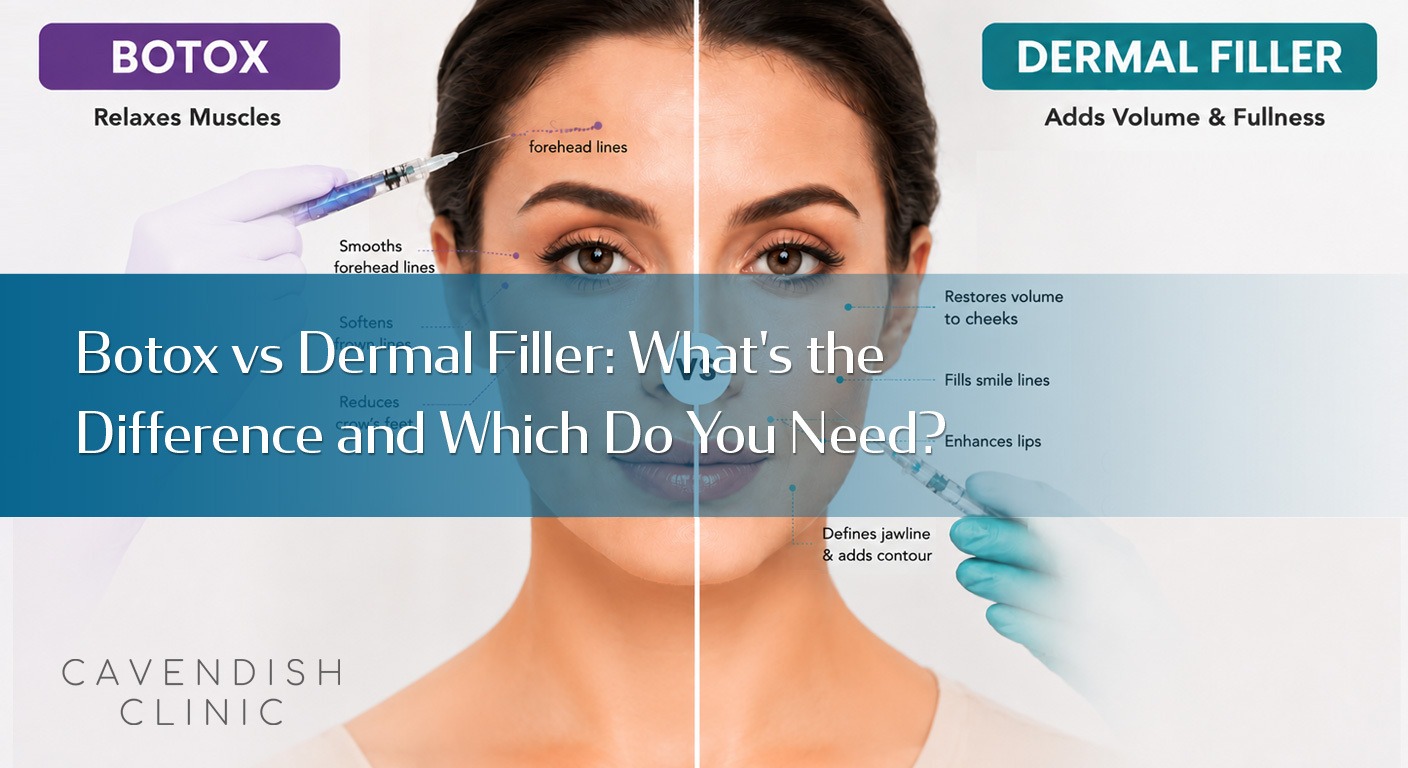
If you are trying to decide between Botox and dermal filler, the short answer is this: Botox relaxes the muscles that cause wrinkles when you move your face, while filler adds volume and structure to areas that have lost fullness. They solve two different problems, so the right choice depends entirely on whether your concern is a moving line or a flat, hollow area. Many people end up needing a bit of both.
Let’s break down what each treatment actually does, how they compare, and which one is likely to suit your face.
Anti wrinkle treatments, more commonly known by the brand name Botox, employ a purified form of botulinum toxin to temporarily relax the muscles under the skin. Dynamic lines are wrinkles that only appear when you frown, smile or raise your eyebrows and they exist due to years of repeated muscle movement. Botox blocks the nerve signal that tells the muscle to contract, relaxing the line without affecting the surrounding tissue .
Common areas treated with Botox include the forehead, the frown lines between the eyebrows, crow’s feet around the eyes, and the jawline for people who grind their teeth. Results usually appear within three to seven days and last around three to four months before a top up is needed.
Dermal filler works on a completely different principle. Rather than relaxing muscles, it uses a gel based substance, most often hyaluronic acid, to restore volume, structure and hydration to areas of the face that have flattened or hollowed out with age. As we get older, the fat pads in our face naturally shrink, which leads to sunken cheeks, thinner lips and a less defined jawline.
Popular filler treatments at Cavendish Clinic include Dermal Lip Filler for fuller, more defined lips, and Dermal Filler Cheeks, Jawline & Chin for contouring and structure. Results are visible immediately and typically last between six and eighteen months depending on the product used and the area treated.
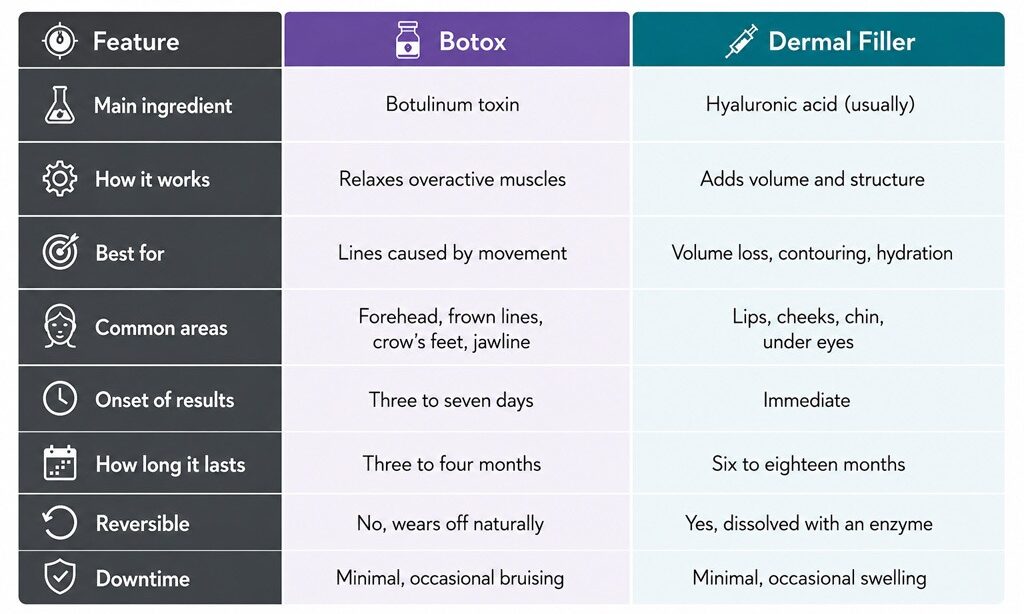
Botox takes a few days to settle in as the muscle gradually relaxes, with full effect visible after around two weeks. Filler works immediately, so you walk out of the clinic already seeing the change, though any swelling will need a few days to fully calm down.
This is one of the biggest practical differences. Botox is broken down by the body within three to four months, so regular top ups are part of the plan. Filler lasts considerably longer, often six months to well over a year, which is why some patients find it more cost effective over time despite the higher upfront price.
Filler has a safety advantage here. If you are unhappy with the result, hyaluronic acid filler can be dissolved with an enzyme called hyaluronidase. Botox has no equivalent reversal option, though its effects fade naturally as the weeks pass.
Choose Botox if your wrinkles only show up when you make an expression, you want to prevent deeper lines forming, you clench or grind your jaw, or you want a subtly refreshed rather than filled look.
Choose dermal filler if your skin looks hollow or has lost its natural shape, you want fuller lips or sharper cheekbones, your lines are visible even when your face is at rest, or you want to enhance your jawline and chin profile.
Choose both if you want a fully balanced result. A common combination is Botox around the eyes and forehead paired with cheek filler, which softens movement lines while restoring the volume that makes a face look rested rather than tired.
Neither treatment improves skin laxity or firmness on its own, since Botox relaxes muscle and filler adds volume rather than tightening tissue. If loose or sagging skin around the jaw or neck is your main concern, you may see better results from skin tightening treatments, which work by stimulating collagen production to firm the skin from within. Many patients combine these with Botox or filler for a more complete rejuvenation plan.
If you are also curious how a deeper skin remodelling option compares with a surface level treatment, our guide on Morpheus8 vs Microneedling covers that comparison in detail.
Before any Botox or filler is carried out at Cavendish Clinic, you will have a thorough consultation with one of our registered doctors. We examine your skin, muscle movement and facial structure, talk through your goals, and set realistic expectations for results. We will also review your medical history, since certain conditions and medications can affect eligibility for injectable treatments.
Many patients also ask about pairing these treatments with Profhilo Skin Booster for hydration, or PRP Skin Therapy to stimulate natural collagen using their own blood plasma, both of which work well alongside Botox and filler rather than replacing them.
The outcome of Botox or filler depends heavily on the skill of the person administering it. Overfilled cheeks, frozen expressions and uneven results are almost always caused by poor technique rather than the treatment itself. This is why choosing a proper Medical Aesthetic Clinic London residents trust matters so much.
At Cavendish Clinic, every injector is a registered doctor or nurse prescriber, and every treatment plan is reviewed before your appointment so the approach is tailored to your face rather than following a one size fits all template. New clients receive a complimentary consultation, giving you the chance to ask questions before committing to any treatment. If you are searching for a trusted Aesthetic Clinic London based, browsing our full range of injectable treatments or getting in touch with our team is the easiest way to find the right plan for your skin.
Botox and dermal filler are not interchangeable. Botox softens the lines caused by movement, while filler restores volume and structure that has been lost over time or was never quite there to begin with. Understanding which concern you are actually trying to fix is the first step toward choosing the right treatment, and a proper in person consultation remains the safest way to get a plan tailored to you rather than guessing based on marketing claims.
Related Read: Anti Wrinkle Treatments in London: Everything You Need to Know Before Booking