
Anti-wrinkle injections remain the most popular non-surgical aesthetic treatment in the UK for good reason. They work. But 2026 has changed the conversation around them in ways that matter if you’re considering treatment for the first time, or even if you’ve been having them for years.
New products have arrived. Regulations have tightened. And the approach to treatment has shifted from “freezing” faces to something far more refined.
This guide covers everything you need to know before booking, based on the latest clinical evidence and our experience treating thousands of patients at our Fitzrovia clinic since 2011.
What Are Anti-Wrinkle Injections, and How Do They Work?
Anti-wrinkle injections use a purified protein called botulinum toxin to temporarily relax specific facial muscles. When those muscles relax, the skin above them smooths out, softening lines and wrinkles that form through repeated facial expressions like frowning, squinting, and raising your eyebrows.
The science is straightforward. Your facial muscles contract millions of times over the years, creasing the overlying skin. Over time, those creases become permanent lines even when your face is at rest. By selectively relaxing the muscles responsible, the treatment gives skin a chance to recover and smooth.
Worth clarifying: “Botox” is a brand name, not the treatment itself. But it earned its reputation for good reason. Allergan’s Botox remains the gold standard in botulinum toxin treatments, backed by over 25 years of clinical data, more than 100 million treatments administered worldwide, and the most extensive safety and efficacy profile of any product in its class. It’s the product we use at Cavendish Clinic, and it’s the benchmark against which every newer formulation is measured.
Other botulinum toxin products are licensed for cosmetic use in the UK, including Azzalure (Dysport) and several newer entrants. The active ingredient belongs to the same class of protein, but the formulations differ in meaningful ways, and not all have the depth of clinical evidence that Botox does.
The Treatment Areas That Make the Biggest Difference
The most commonly treated areas fall into what practitioners call the “upper face triad,” though modern treatment goes well beyond these.
Forehead lines run horizontally across the forehead and deepen every time you raise your eyebrows. The frontalis muscle is responsible, and treating it can take years off your appearance. Getting the dosage right here matters enormously. Too much and the brow can feel heavy; too little and the lines persist.
Frown lines (glabellar lines) are the vertical creases between the eyebrows. The corrugator and procerus muscles pull the brows together when you concentrate or frown. These lines can make you look tired, stressed, or even angry when you’re perfectly content. It’s one of the most satisfying areas to treat because the difference in resting expression is often dramatic.
Crow’s feet are the fan-shaped lines radiating from the outer corners of your eyes. Caused by the orbicularis oculi muscle, they appear every time you smile or squint. Treatment here requires a delicate touch since the muscle also controls your lower eyelid.
Beyond the upper face, experienced practitioners now routinely treat several other areas. A “lip flip” relaxes the muscle around the upper lip, allowing it to roll slightly outward for a subtle fullness without filler. Bunny lines across the nose, dimpled chin, and a downturned mouth can all be addressed. Masseter reduction for jawline slimming and even neckbands (platysmal bands) respond well to carefully placed injections.
The key phrase here is “experienced practitioner.” These extended areas demand detailed anatomical knowledge. At Cavendish Clinic, all injectable treatments are performed exclusively by doctors, which is not the case at every clinic.
What’s New in 2026: Next-Generation Treatments
The botulinum toxin market has expanded significantly over the past two years. Allergan’s Botox remains the established leader with the longest clinical track record, but several newer formulations now offer practitioners and patients additional options worth understanding.
Allergan’s Botox: Still the Gold Standard
Botox earned its position through decades of clinical use, and nothing that’s arrived since has displaced it. It has the largest body of published research of any botulinum toxin product, the most predictable dose-response relationship, and a safety profile refined over more than 25 years of cosmetic use. For practitioners who value consistency and reliability, it remains the first choice, and it’s the product we use exclusively at Cavendish Clinic.
What sets Botox apart is precision. Experienced injectors know exactly how it diffuses, how quickly it takes effect (typically three to five days), and how long results will last (three to four months for most patients). That predictability matters when you’re working millimetres from the eye or shaping a brow.
Newer Formulations Worth Knowing About
Alluzience is a liquid-ready neuromodulator from Galderma that doesn’t require reconstitution (mixing with saline) before injection. That removes a variable from the process. Clinical data shows onset within 24 hours for many patients, and effects lasting up to five or six months in some cases. For patients who found traditional formulations wore off too quickly, this may offer benefits.
Relfydess, also from Galderma, uses proprietary PEARL Technology and is showing impressive Phase 3 clinical results. Studies presented at TOXINS 2026 demonstrated over 98% efficacy in treating frown lines at the one-month mark. It’s another ready-to-use liquid formulation with sustained efficacy of up to six months.
Letybo, developed by Hugel Pharma in South Korea, has gained ground across Europe and the UK. It offers practitioners flexibility with 50-unit and 100-unit vials, and has built a solid reputation for consistent results.
These newer products sit alongside the established Azzalure (Dysport). Each has its own characteristics, and your practitioner should be able to explain why they’ve chosen a particular product for your treatment.
What does this mean for you? More options exist than ever before. But the product matters less than the person injecting it. A skilled doctor using Botox with a thorough understanding of facial anatomy will consistently outperform a less experienced injector using the newest formulation. That’s why at Cavendish Clinic, we pair the gold-standard product with doctor-led treatment as standard.
Related Blog : Anti-Wrinkle Treatments, What Should I Know?
The 2026 Regulatory Picture: Why It Matters to You
The UK has taken significant steps to regulate non-surgical cosmetic procedures, and patients should welcome this.
From 2025, new rules from the Nursing and Midwifery Council require face-to-face consultations before prescribing botulinum toxin. This may sound obvious, but it effectively closes a loophole that allowed remote prescribing, where practitioners could prescribe without ever meeting the patient in person.
The government’s broader regulatory framework classifies anti-wrinkle injections as an “amber category” treatment, reflecting their moderate risk profile. A new local authority licensing system means practitioners must demonstrate rigorous safety standards, proper training, and adequate insurance before offering these treatments legally.
Research from UCL published in February 2026 highlighted that the industry has, in some areas, outpaced regulation, with cheaper treatments more prevalent in underserved areas where specialist oversight is less common.
So what should you look for? A practitioner who is a prescribing medical professional (doctor, dentist, or nurse prescriber), who performs a thorough face-to-face consultation, who discusses your medical history, expectations, and potential risks before touching a needle.
At Cavendish Clinic, our treatments have always been doctor-led. We’ve operated this way since our founding because it’s the safest approach, not because regulations required it. The new rules simply formalise what we’ve always believed: injectable treatments belong in clinical hands.
What to Expect: Before, During, and After Treatment
Your consultation is the most important part of the process. A good practitioner will assess your facial anatomy at rest and during movement, discuss your concerns and expectations, and explain what treatment can realistically achieve. They’ll also review your medical history, current medications, and any previous cosmetic treatments.
Be honest during this conversation. Certain medications (blood thinners, for example), medical conditions, and even supplements like vitamin E or fish oil can affect treatment outcomes and bruising risk.
The treatment itself typically takes between 15 and 30 minutes. After cleansing the skin, your doctor will make several small injections using ultra-fine needles into precisely targeted muscles. Most patients describe the sensation as a brief sting or pinch. Some areas, particularly around the eyes, are more sensitive than others, but discomfort is generally very manageable.
Immediately after, you may notice small raised bumps at injection sites. These settle within 20 to 30 minutes. Mild redness is common and fades within hours. Bruising occurs in a minority of patients and, when it does appear, typically resolves within a few days.
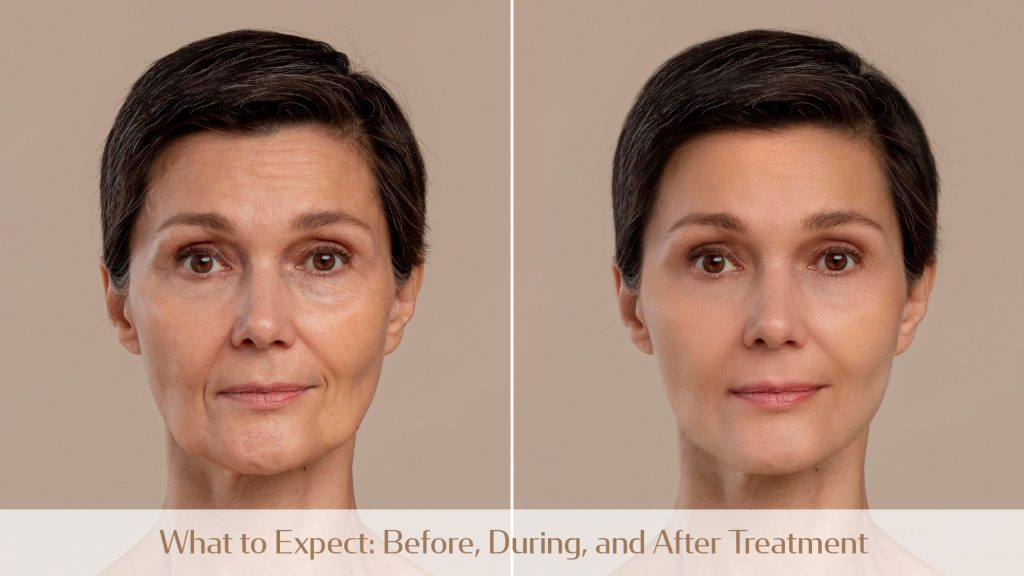
Results timeline: You won’t walk out looking different. Initial effects usually become noticeable within two to five days, with full results visible at the 10 to 14 day mark. We schedule a review appointment at two weeks to assess the outcome and make any adjustments if needed.
How long does it last? With traditional formulations, expect three to four months. Newer products like Alluzience and Relfydess may extend this to five or six months for some patients. Regular treatment tends to train the muscles to relax, meaning some long-term patients find they need treatment less frequently over time.
Aftercare: The Do’s and Don’ts
Proper aftercare helps ensure optimal results and minimises the small risk of complications.
In the first four hours: Remain upright. Avoid touching, rubbing, or pressing the treated areas. This helps prevent the product migrating away from the intended muscles.
In the first 24 hours: Skip intense exercise, hot baths, saunas, steam rooms, and excessive alcohol. These can increase blood flow and swelling, potentially affecting how the product settles.
In the first two weeks: Avoid facial massages, face rollers, and any treatments that involve firm pressure on the face. If you have a dental appointment scheduled, let your dentist know you’ve had injections.
Ongoing: Wear broad-spectrum SPF daily. Sun damage accelerates the very skin ageing that anti-wrinkle treatments address. Protecting your skin maximises the longevity and quality of your results.
How Much Do Anti-Wrinkle Injections Cost in 2026?
Pricing varies considerably across the UK, and Central London sits at the higher end of the range.
National data from a study of nearly 1,000 UK clinics in March 2026 shows median pricing of around £170 for a single treatment area, £220 for two areas, and £270 for all three upper face areas combined. In Central London specifically, a three-area treatment has a median cost of approximately £310.
Prices vary by up to 2.5 times between the cheapest and most expensive clinics. That gap reflects real differences in practitioner qualifications, product quality, clinic environment, and aftercare provision.
Our advice: don’t shop on price alone. The cheapest option often means a less experienced practitioner, a lower-quality product, or both. Your face deserves better than a bargain-basement approach. Look for transparent pricing, a clear explanation of what’s included (consultation, review appointment, product used), and a practitioner whose qualifications you can verify.
At Cavendish Clinic, our pricing is available on our website, and every treatment includes a full consultation, the treatment itself, and a complimentary review appointment at two weeks.
Who Is a Good Candidate?
Anti-wrinkle injections suit a broad range of adults, but they’re not right for everyone.
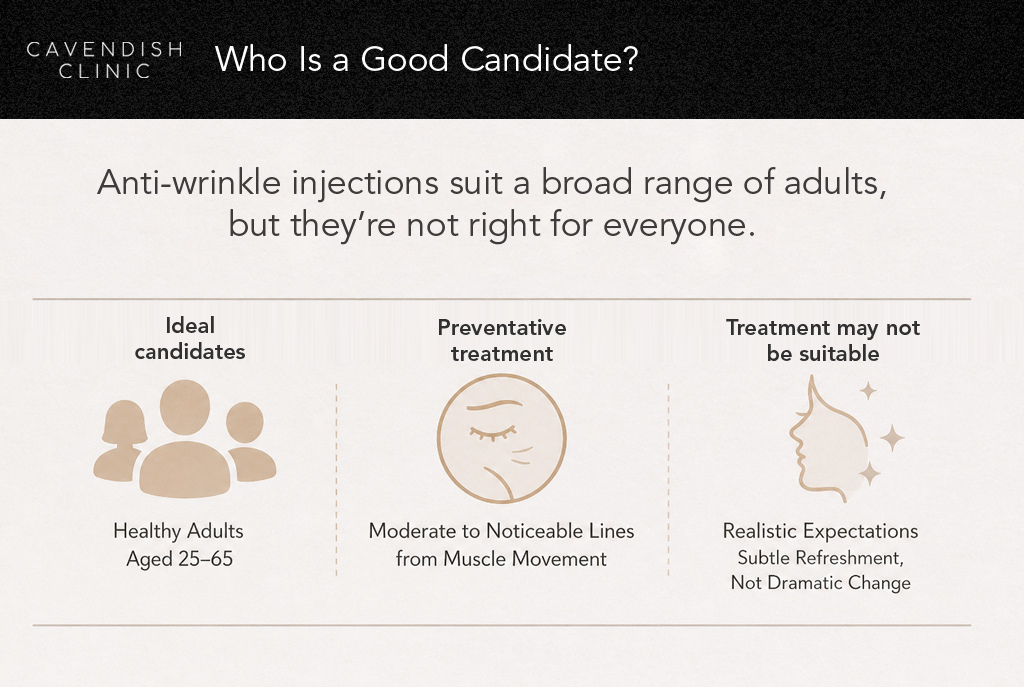
Ideal candidates are generally aged 25 to 65, in good overall health, with moderate to noticeable lines caused by muscle movement. They have realistic expectations about what the treatment can achieve and are looking for subtle refreshment rather than a dramatic transformation.
Preventative treatment has become increasingly popular among patients in their late twenties and early thirties. By starting before deep static lines form, lower doses can maintain smooth skin and potentially delay the need for more intensive treatments later on. The approach is less about “freezing” and more about gentle muscle relaxation.
Treatment may not be suitable if you are pregnant or breastfeeding, have a neurological condition such as myasthenia gravis, have an active skin infection at the intended treatment site, or are taking certain medications. Your practitioner will assess all of this during your consultation.
Doctor-Led vs. Non-Doctor-Led: Why It Matters
Not all clinics operate the same way. Some use nurses, beauticians, or even unregulated practitioners. The 2026 regulatory changes are beginning to address this, but patients still need to be informed.
Doctors spend years studying anatomy, pharmacology, and patient assessment. When something unexpected happens during treatment, and occasionally it does, medical training provides the foundation for safe, confident management. A doctor can also prescribe the product directly, meaning your treatment pathway stays within one pair of hands.
At Cavendish Clinic, every anti-wrinkle treatment is delivered by Dr Luca Karadaghi; an experienced Plastic Surgeon using Allergan’s Botox, under the clinical oversight of Mr Matthew James, our Medical Director and Consultant Plastic Surgeon with over 20 years of experience at institutions including Guy’s and St Thomas’ NHS Trust. We believe the combination of gold-standard product and doctor-led delivery gives our patients the safest, most predictable results.
This isn’t a marketing distinction. It’s a safety one.
Common Concerns and Honest Answers
“Will I look frozen?” Not with a skilled practitioner. Modern treatment philosophy prioritises natural movement and expression. The goal is to soften lines while preserving your ability to show emotion. The “frozen forehead” look is the result of over-treatment, and it’s entirely avoidable.
“Does it hurt?” Most patients find it far more comfortable than they expected. The needles are exceptionally fine, and the injections are quick. Some areas are more sensitive than others, but genuine pain is rare.
“What if I don’t like the results?” The effects are temporary. If you feel over-treated, the product will gradually wear off over weeks to months. Your practitioner can also adjust future treatments based on your feedback. This is one of the great advantages of anti-wrinkle injections over permanent procedures.
“Is it addictive?” Not in any pharmacological sense. Some patients find they enjoy the results and choose to maintain them, which is a personal preference rather than a dependency.“Can I combine it with other treatments?” Yes, and many patients do. Anti-wrinkle injections pair well with dermal fillers, skin boosters like Profhilo, and skin-quality treatments such as HydraFacial or chemical peels. Your practitioner can design a treatment plan that addresses multiple concerns in a complementary way.